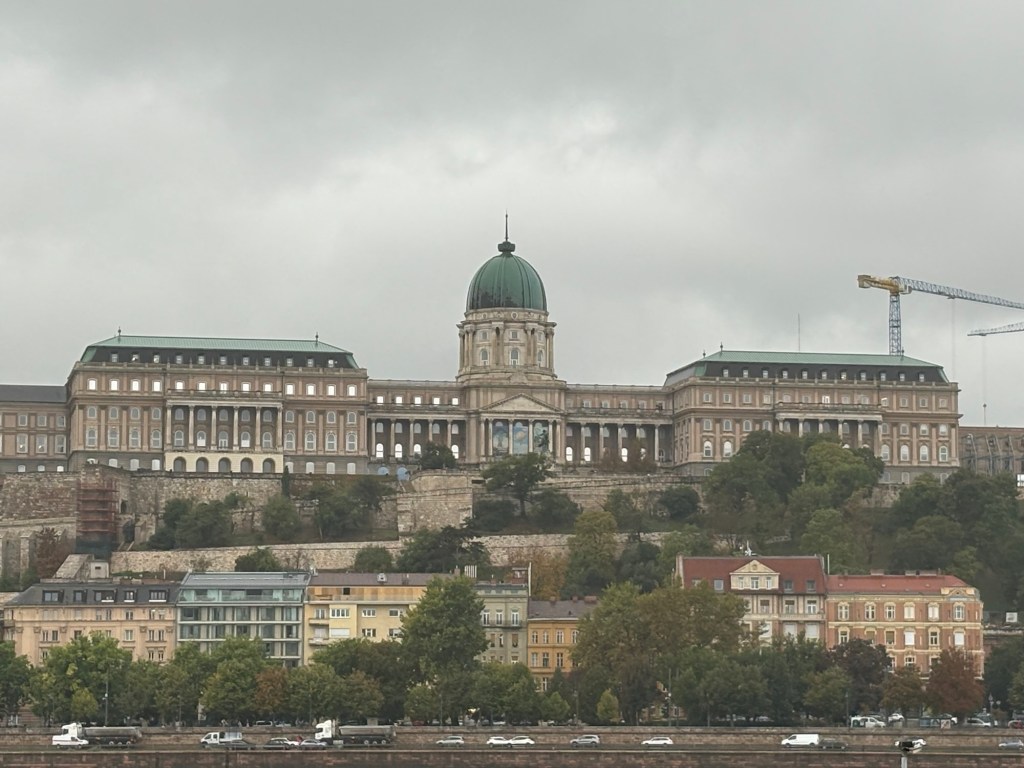
Luis and I venture out in rain to see the Buda Castle and also find a laundry mat during our last days in this imperial and impoverished city. Both the tourist outing to the Castle and the mundane venture to wash our clothes were appreciated in their own rights.
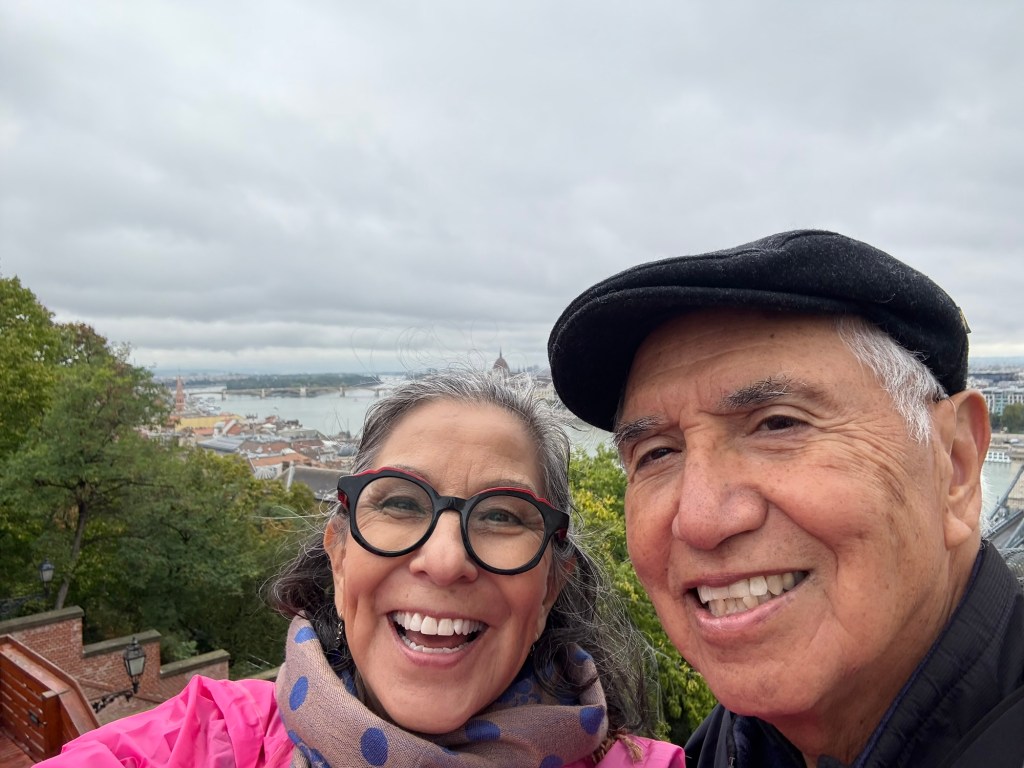
The weather turned chilly and rainy on us. This small fact doesn’t bother the local people on their way to work or school. But for those of us who packed as lean as possible it brought a “shoppertunity”. The last remaining rain jacket in the store we went into was loud pink. Luis said buy it!
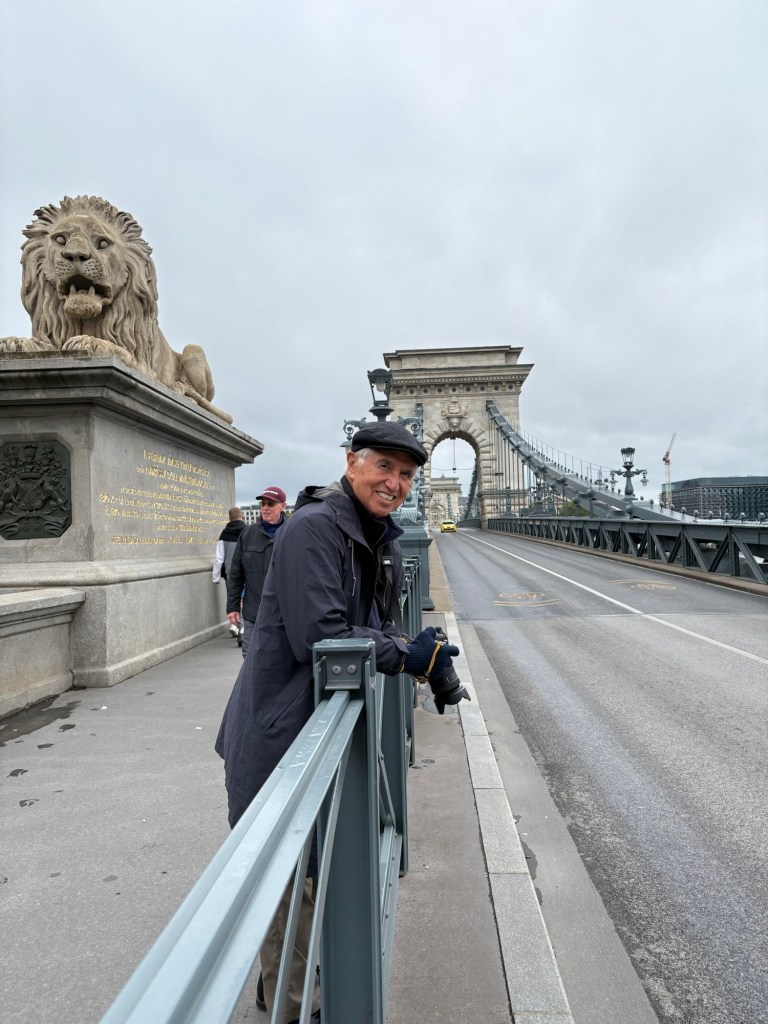
We cross a gorgeous lion bridge to the old town of Buda, over the Danube and the Viking River Cruise boats jambing the water. We forewent the funicular and opted for the “steep and difficult” foot path up the hill. It was neither too steep nor too difficult. It reminded us of the Camino de Santiago as it was a natural path, wooded, calm and, drippy with rain off the leaves.
We walked around the ramparts and tried to visit Matthias Church (Nagyboldogasszony-templom) but it was only open for ticket holders. I don’t understand how a church could charge to enter, but it’s not the first time I see that. It won’t be the last. The scenic view of the city below outweighs the small inconveniences.
Now we set off to wash clothes. This chore is rarely given attention in the Instagram culture. But it is an instructive activity. We go into the real life of Budapest. We find a spot and while the attendant takes care of it, we wander the neighborhood, find a charity thrift shop and spend time pantomiming with the North African shop clerk. I buy a crocheted cloth that I plan to incorporate into a light jacket or top.
Our clothes come out clean and fresh. And we are off to have dinner and drinks before we leave our next destination.
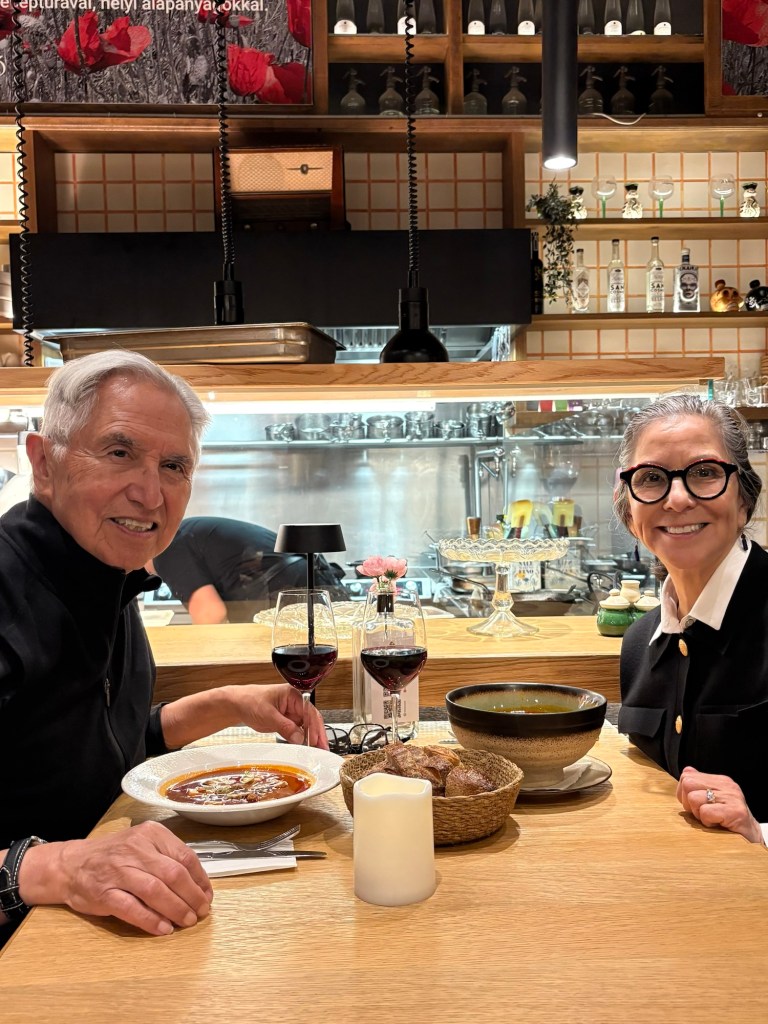
Our final stop is for a glass of wine. This is a splurge compared to a similar glass in Austria. Food, beer and wine has consistently been more expensive than in Vienna. Maybe it’s just the places we go to, or that’s just the way it is.
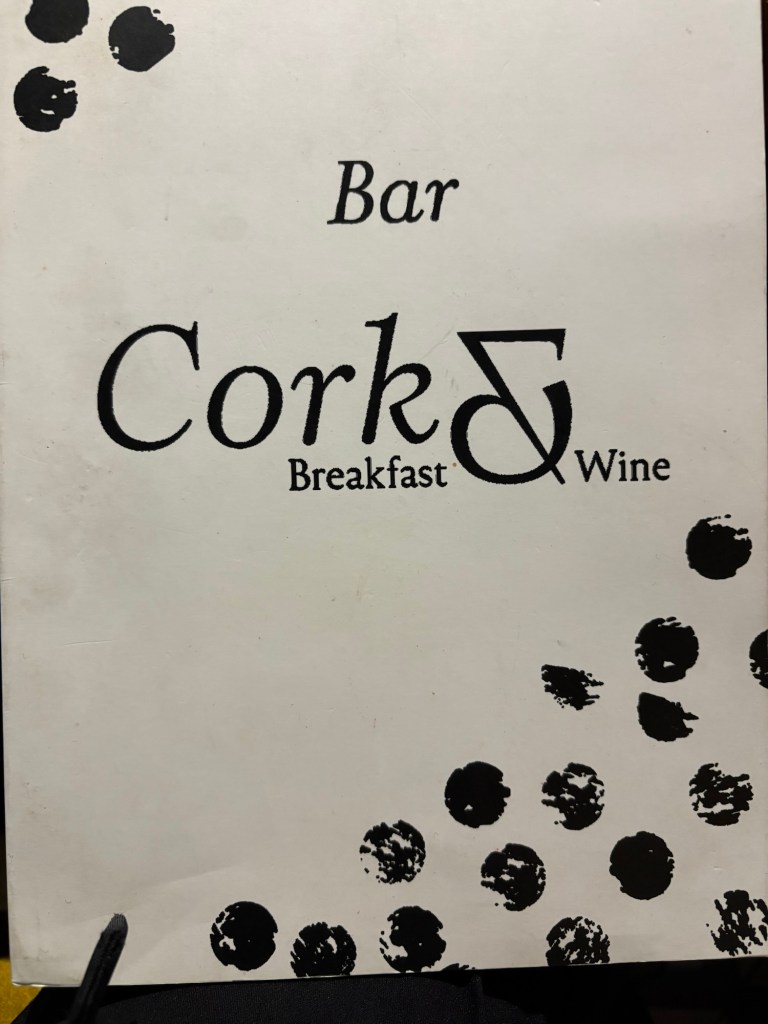
We enjoy our last glass of local wine at a place behind the Opera House. It’s called Cork and Breakfast Bar. We will never know about how they pull off the combination in the mornings. It’s late for us and we have a shuttle early in the morning so it’s off to bed for us.
Who would’ve known that we would get a tour of the Art Deco and more of Budapest from an expert in political economy, elections and history? Our guide, Ändras Palatitz, a local 30-something-year-old was phenomenal.
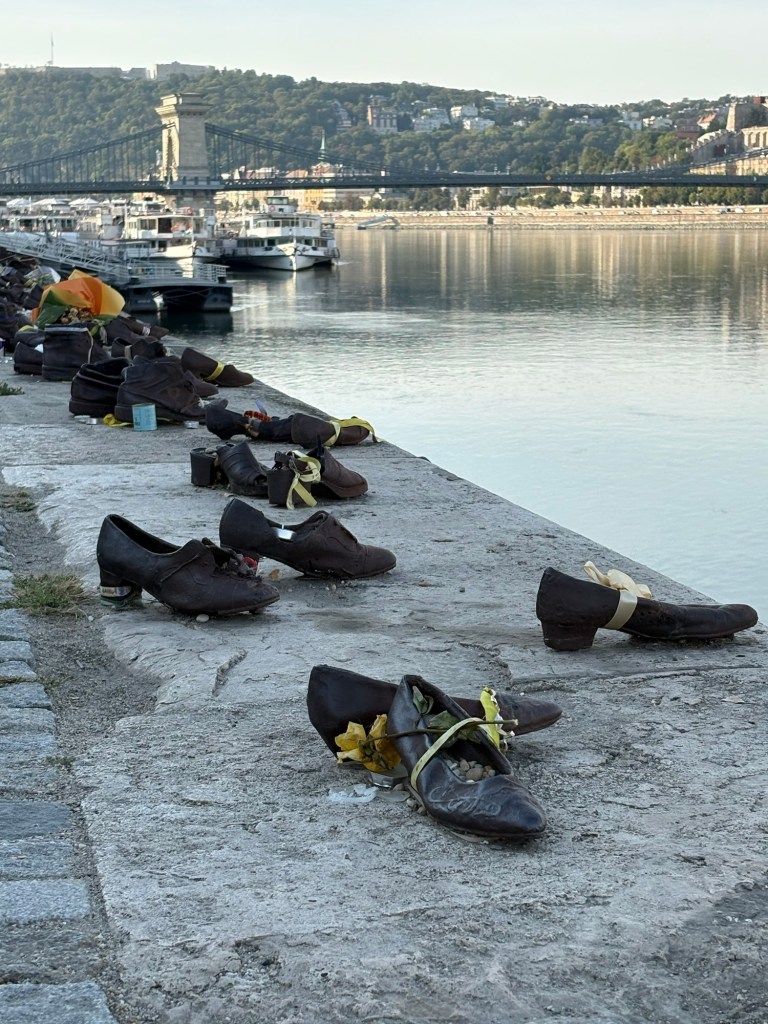
Bronzed shoes remembering the Jews shot on the spot and dumped into the Danube
We meet at the Ferris wheel, exchange basic personal information. We start by visiting two shops specializing in a time-honored glazed ceramic technique. I appreciate the fine lines of the statues and gilded serving patterns, and the hallmark fountains in the négyzet (square) just outside the flagship stores. Luis gets the best camera angle to avoid reflection. I think our guide, Andras Palatitz knows I don’t want to spend “that kind of money”.
So he lets us in on a secret. Many Hungarian families owned the dinner service sets and hung on to them through WW2, through the restrictions of the USSR and through the lean years of Hungarian independence. But they pawn them and any collector can buy them at a bargain price at secondhand shops.
That leads us into a discussion about secondhand shops. We learn that donations from all over Western Europe first stop in Hungary before being shipped to Africa. Regular Hungarians—not those in the central circle of Prime Minister for life Orban, his political friends, or his immediate family members, or the Saudi princes with homes here—have limited wardrobes from vintage shops. The shops are everywhere, with the exception of the tourist area, the thoroughfares lined with luxury shop such as Louie Vuitton.
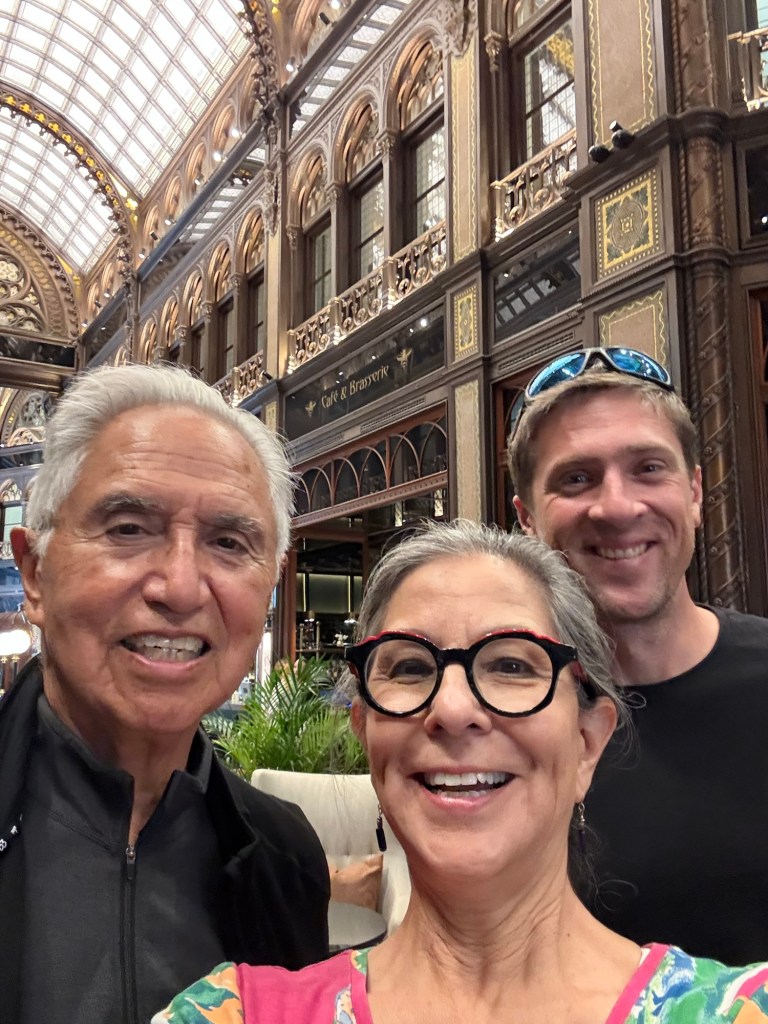
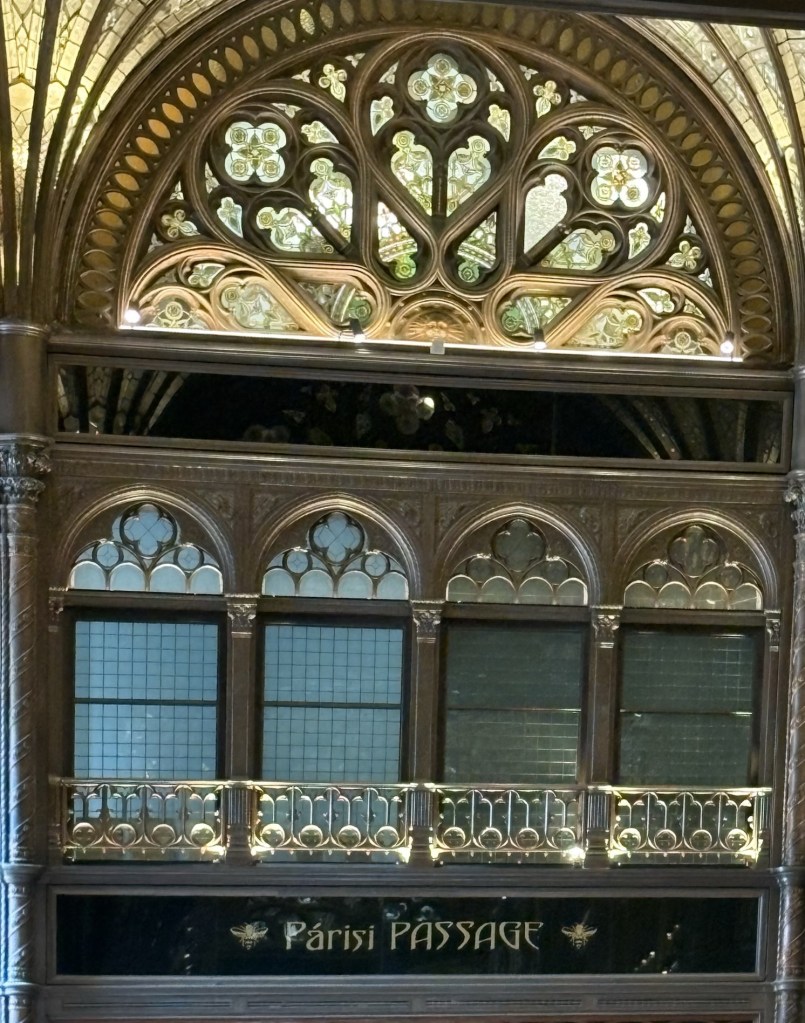
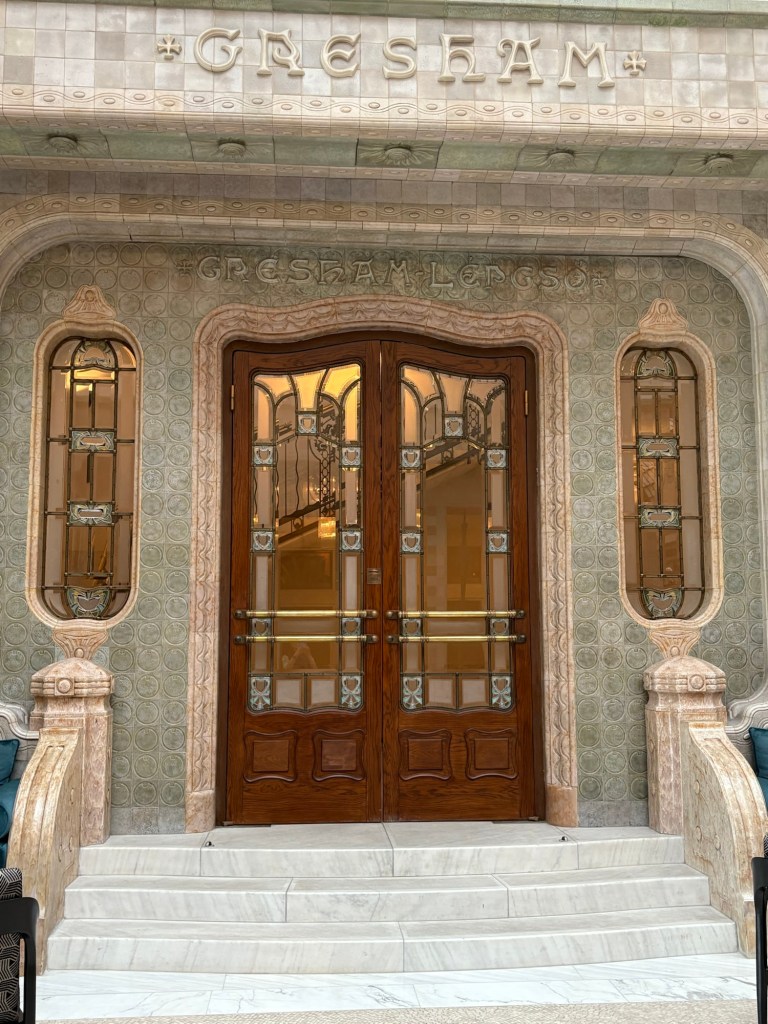
Ändras takes us through the 5-star hotels that are opulently rehabilitated to their former glory. We see the Four Seasons, build originally for the Grisham Insurance company around 1904 on the banks of the Danube. It is breathtaking. We see the lobby of the W Hotel in green velvet seating, stained glass, and tiled bar. Breathtaking. We go across the street to the state opera house to see it, too, dripping in gold and oozing wealth. Extra breathtaking. The Parisi Udvar, extra, extra… well, you get the idea.
The Four Seasons Hotel interior
We take a ride on the metro with Ändras. We go up town to residences and see large palaces now owned by embassies and the international jet set. They, too, are extravagant. One of these is owned by a bank. It sponsors artists, then owns their work, puts it on display. And has an investment should the time comes when the bank needs to raise capital.
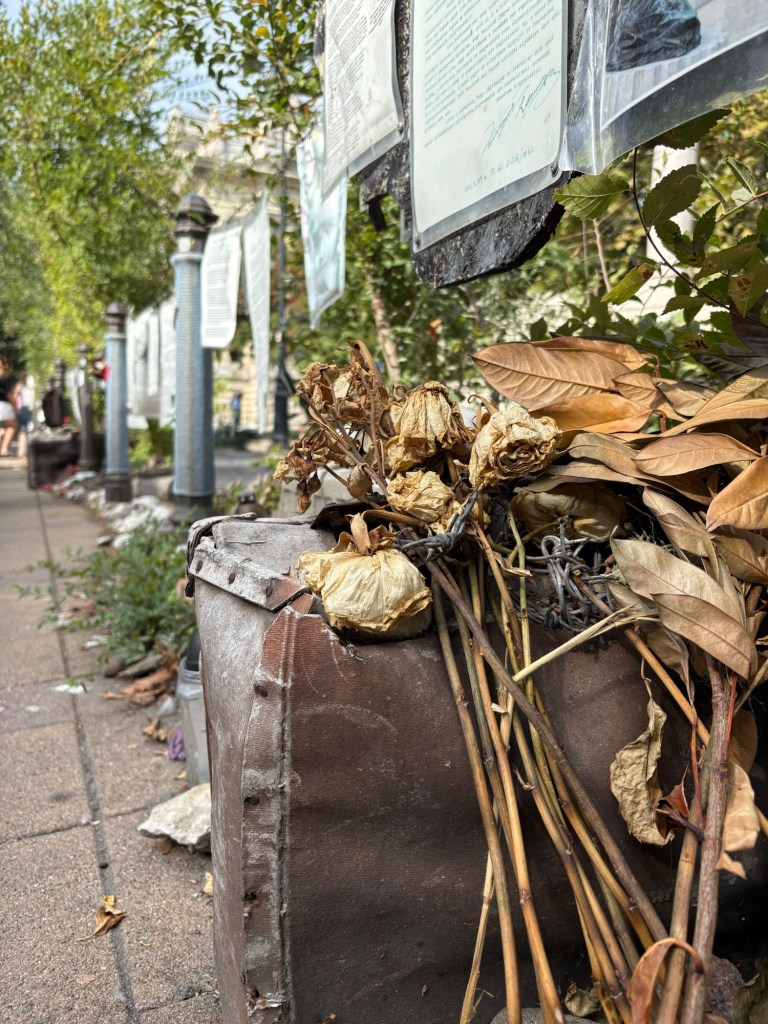
Along with the Art Deco we see the largest synagogue in Europe. Our guide tells us of another one nearby. We see the sad memorials to the victims of the Hungarian and German Nazis. The Hungarian government erected a memorial with an interactive fountain and placed the blame only on Germans. Local Jewish community corrected the version, calling out the homegrown Nazis. The Jewish family members of victims put up a counter memorial next to the fountain with very personal artifacts and flowers for their loved ones.
There is an awful lot of filming here. We see two major productions. One is in the embassy area, another in a dilapidated, yet to be remodeled building on Andrássy. We find out that many film about WW2 and the Cold War are filmed here. The sets are authentic and not much needs to be done to convey the bombed out buildings or gritty gray palettes. Directors have many buildings to choose from.
We eat at Pipa Étterem next to a lovely covered market place. The restaurant is a small family-run place with a mix of residents and some tourists. The large lunch is tasty. The spices are excellent especially the paprika paste. Luis buys a bottle and we wind our way back to our hotel to rest our feet and absorb and that we’ve learned.
We end our day back at our hotel, the W Budapest (!) and put our feet up, exhausted and full of much to consider. Tomorrow we plan to go to Buda Castle.
Adventure. That’s an appropriate word to describe our trip to Budapest from Vienna. Very adventurous, indeed.
I arranged this part of our 40th anniversary trip soon after getting our flights after researching online. I discovering that the Austrian trains system is more modern and reliable than the Hungarian national railway system. So things are set with Austrian ÖBB train.
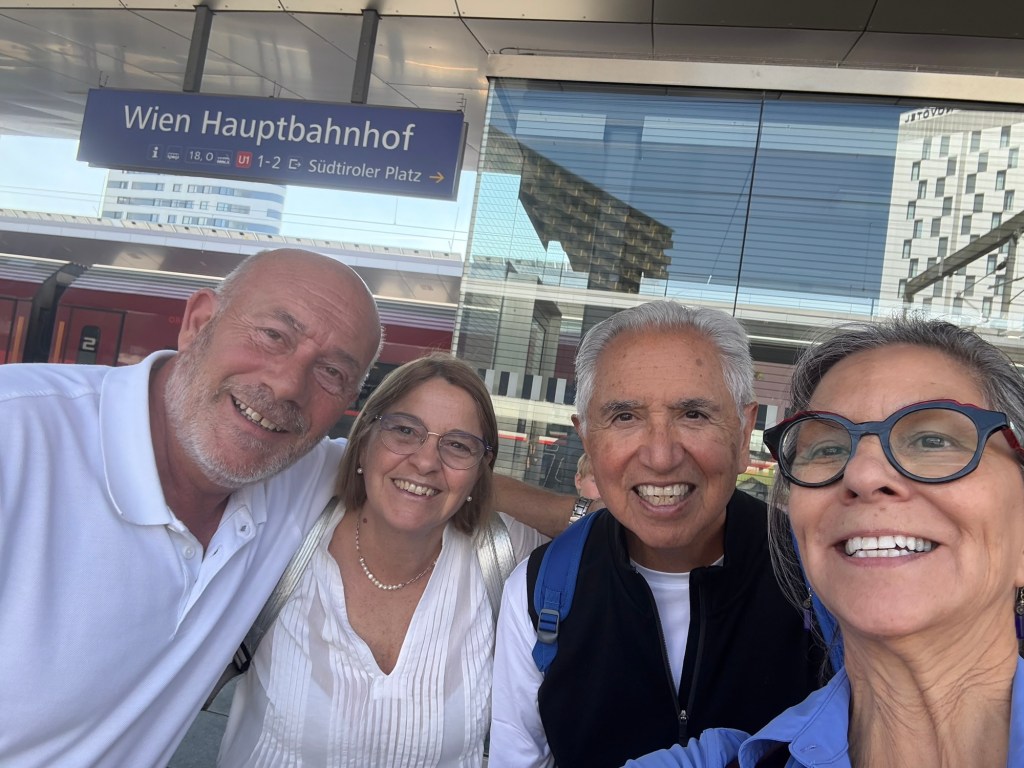
We arrive with plenty of time at the Hofbahnhauf train station. It’s large station, sparkly, well maintained and relatively new. Yet, our train is delayed by 2 hours. We make friends with a couple from Argentina, Claudio and Mariaopel.
Argentinian travel partners with Luis and I
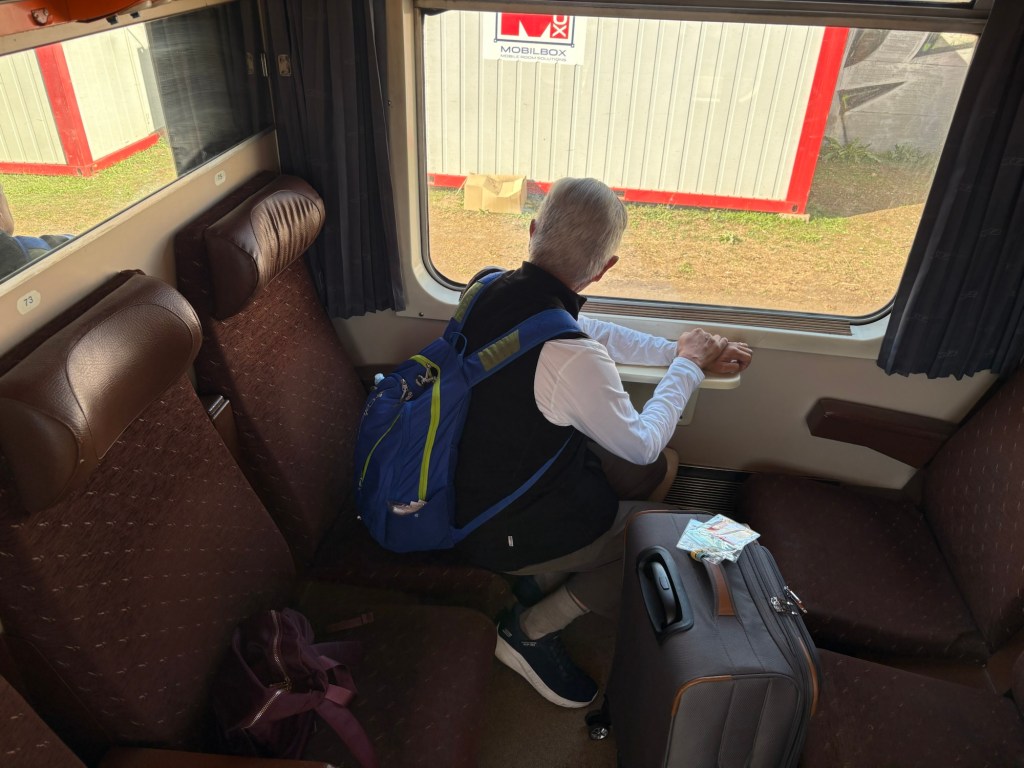
We wait together for two hours then board the train. I count the 4 stops before Budapest-Keleti. We have the compartment to ourselves. The fabric of the 6 seats in the compartment is clean, utilitarian, dun-color, a bit worn. I had been warned by YouTuber “Man in Seat 64” that the Hungarian national train system hasn’t been uniformly modernized so I’m not surprised. The PA speaker in the compartment doesn’t work. In fact, none of the speakers in the wagon work. I guess that’s a perk if you get a 1st class ticket. But I bought 2nd class seats figuring that regardless of the class, we all arrive at the same time.
Luis “supervising” the line workers.
A 20-minute stop in the outskirts of Budapest and then we continue…but in the wrong direction. No announcement in English, or German, or Hungarian. Nothing on the app. We are going away from Budapest toward Romania. All of a sudden my motion sickness goes away and I run through 3 wagons, swaying the whole way to find an attendant.
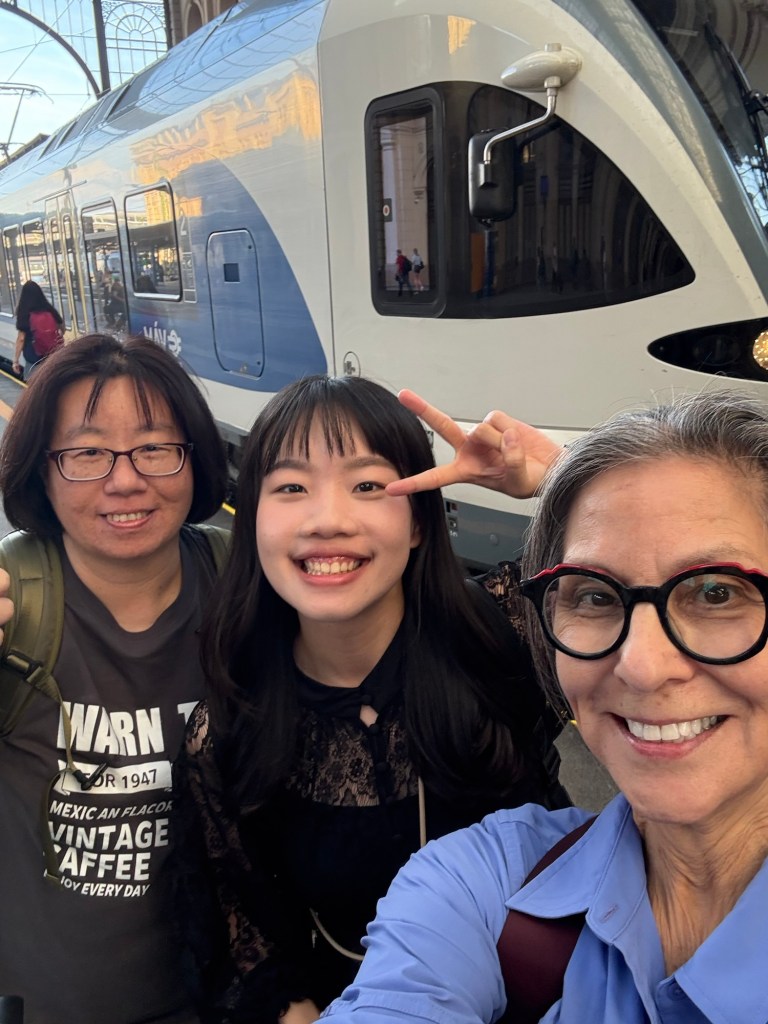
The charming, English-speaking ÖBB attendant, in his crisp white shirt, is no longer with us. There are two MAV attendants from the Hungarian national train company in the hallway of 1st class (where the PA system works) who are super interested in understanding my concern, though they don’t speak a word of English. I can’t even say hello in Hungarian so I throw no stones. We pantomime. A lot. Google translate on “conversation mode” sputters and is barely helpful due to spotty reception. I finally understand: the rail line is closed and we should’ve gotten off at the 20 minute stop. The train has just skipped Budapest-Keleti station. I understand Mr. Pony Tail —he has a small graying ponytail distinguishing him from Mr. Walkie Talkie Ahead— wants to know how many of us need alternate arrangements. I hold up “two” like a peace sign. He cocks his head in confusion. Then his eyes light up and he holds up a thumb and index finger, nods, says something, and nods. He indicates for me to show them where my Number Two is and we all run back through the wagons toward Luis who is waiting with our luggage. Mr. Pony Tail and Mr. Walkie Talkie help us get our luggage out into the hallway, to the wagon door and off the train. They also help two Taiwanese ladies. I didn’t know I was advocating for the group. We are motioned to go over to the other lines, and get on the next train arriving in 4 minutes going the direction we just came from.
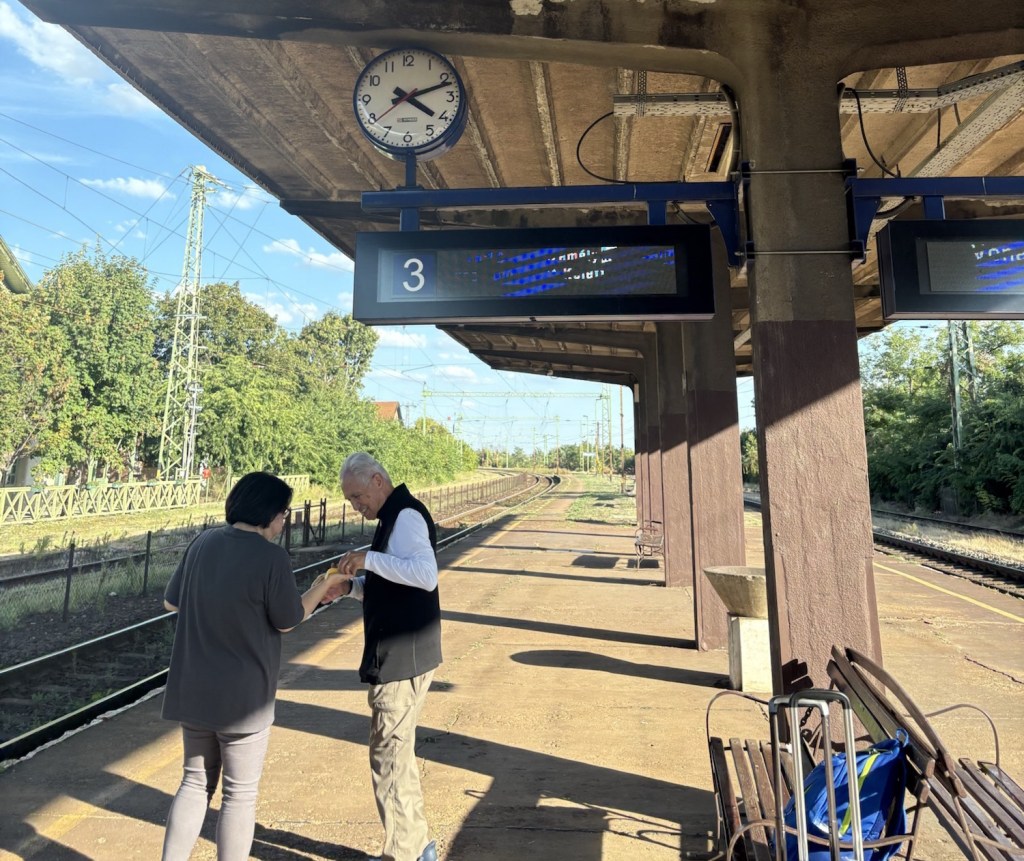
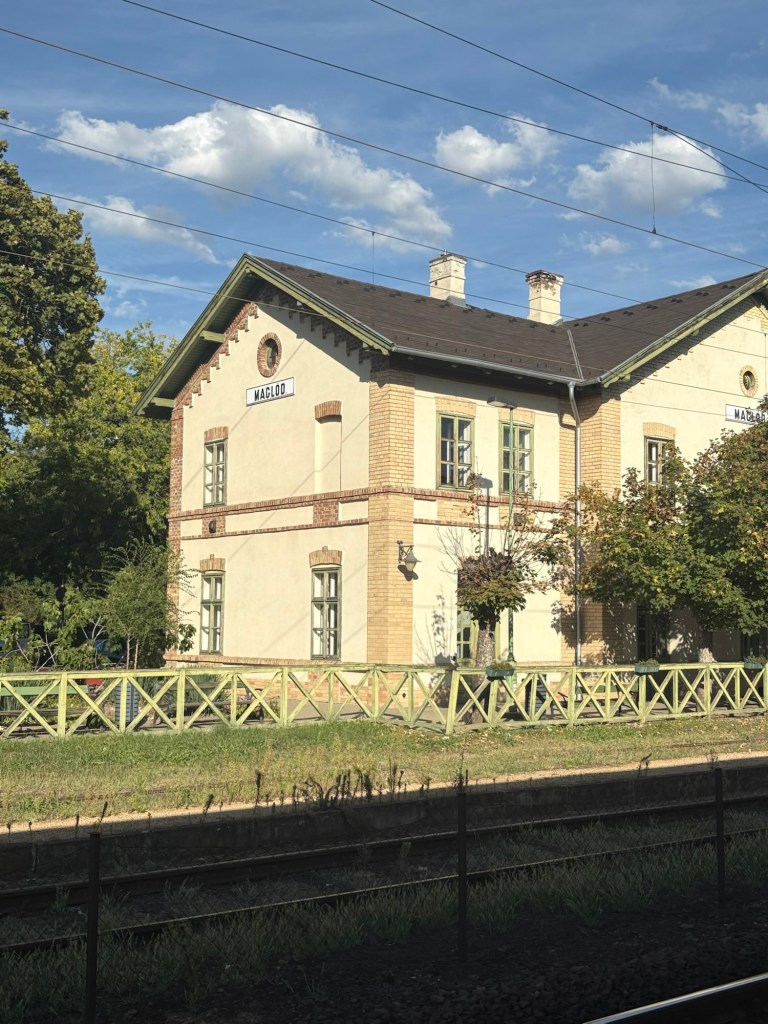
We get off in the tiny town of Mosglov. We all run through the tunnel but can’t find the other set of tracks. The station is closed. There is nobody around except us four. I approach workmen in a pickup. Maybe they work for the train system. Maybe not. We don’t speak each other’s languages but they understand “Budapest.” One of the guys takes us back through the tunnel and shows us to wait here for the next train.
Masglov train station
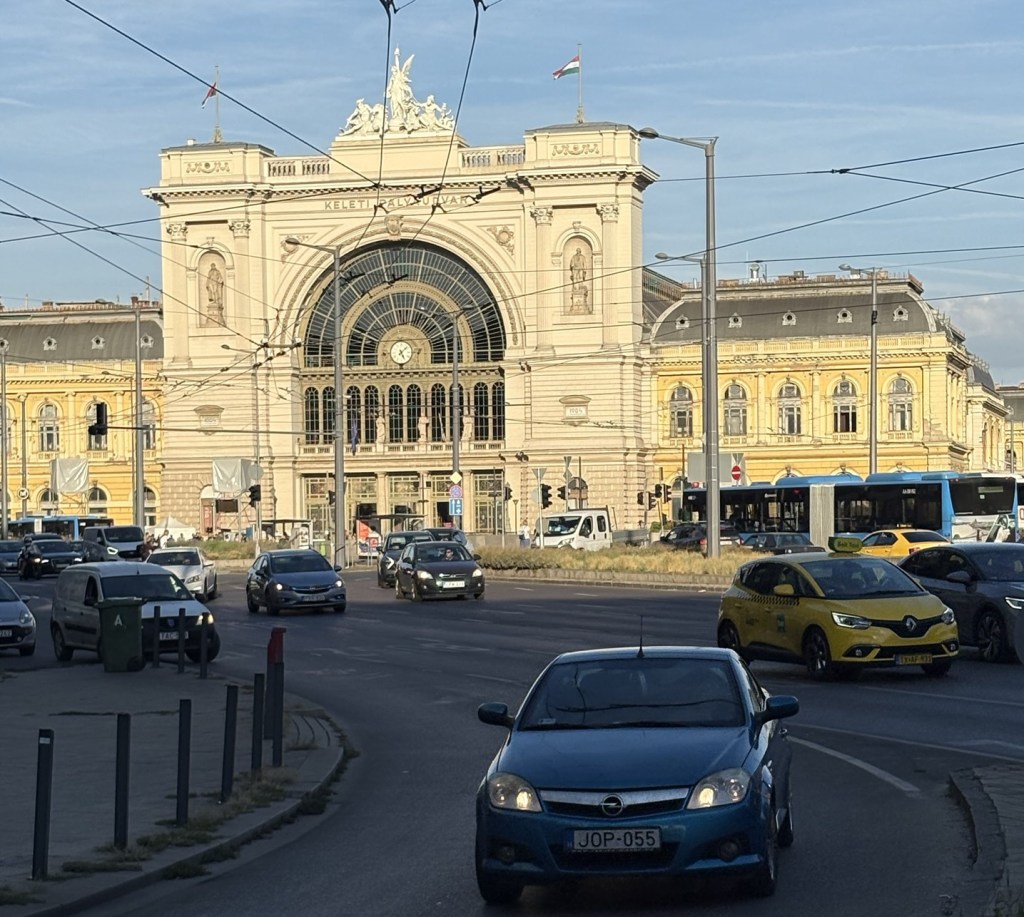
The commuter train we get on is clean, brightly apholstered, and has a bathroom. We finally get in to impressive Budapest-Keleti.
We quested beyond the immediate palaces and museums to a district with designer shops and people going about their business.
First off, Luis and I made our way to a restaurant called Gasthaus Grünaur. It’s a local place, popular and busy. Its connection to us is through my brother Dio and sister-in-law Stephanie. It is nice to see someone a family member knows. Unfortunately, the restaurant had a private event and couldn’t accommodate us. At Cristian’s suggestion, we went next door to Tenha’s and had a marvelous seafood meal.
Cristian, owner of Gasthaus Grünnaur. His wife was busy in the kitchen.
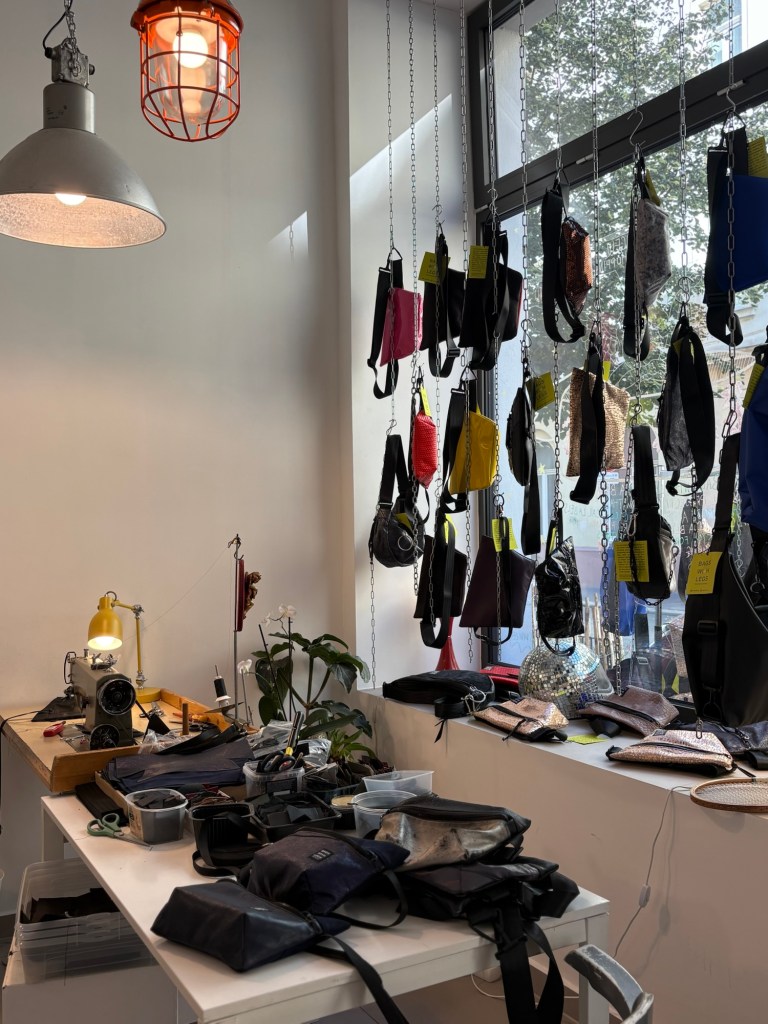
We spend the next day wandering in the same section of Vienna where we stumble upon a neighborhood used book and clothing sale. And then we see numerous small shops. One is a co-op run by Muslim women who made lovely handbags. Another is some kind of wood working shop.
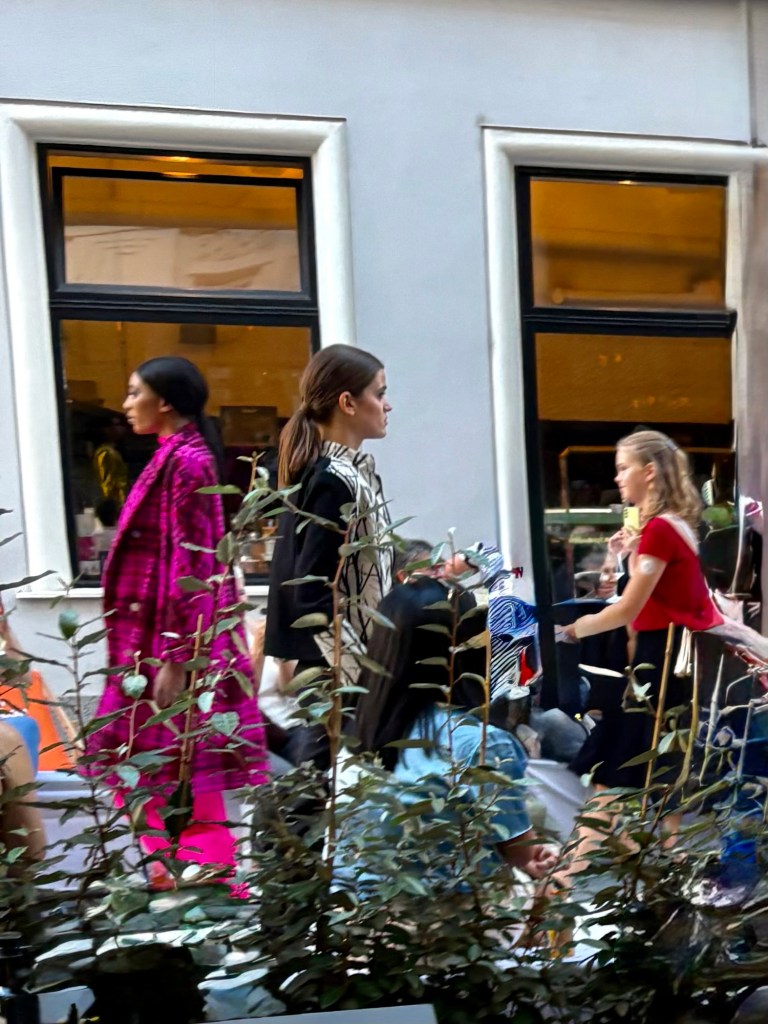
And then the tiny designer shops. They are everywhere. I chat with a women who’s clothing is refreshing and something that I’d actually wear. Shortly after this we eat outside at a pizzeria next to what is apparently a runway. Nobody wants our table so we sit and have wine after lunch while a fashion show proceeds right up next to us. It is delightful and an unplanned sparkle to an already enjoyable day.
The professional models were supplemented by a small group of pre-teen wannabe models.
Four days in Vienna and we want more. But we leave for Budapest tomorrow. We will have breakfast in the hotel, a bargain with Stephanie’s generous hookup. But we won’t linger as we have a 10:40 train to catch.
Museums, monumental buildings, cafes and random ramblings. All typical fare for us, for tourists.
A fashion runway show, secondhand clothing store, co-op purse workshops, and chats with a clothing designer in her shop . Each a respite from the frenzy of tourist traps.
We are pleasantly surprised at the welcoming warmth of the Austrians. They seem to embrace immigrants and people of color. Their patience with my lack of German language is appreciated.
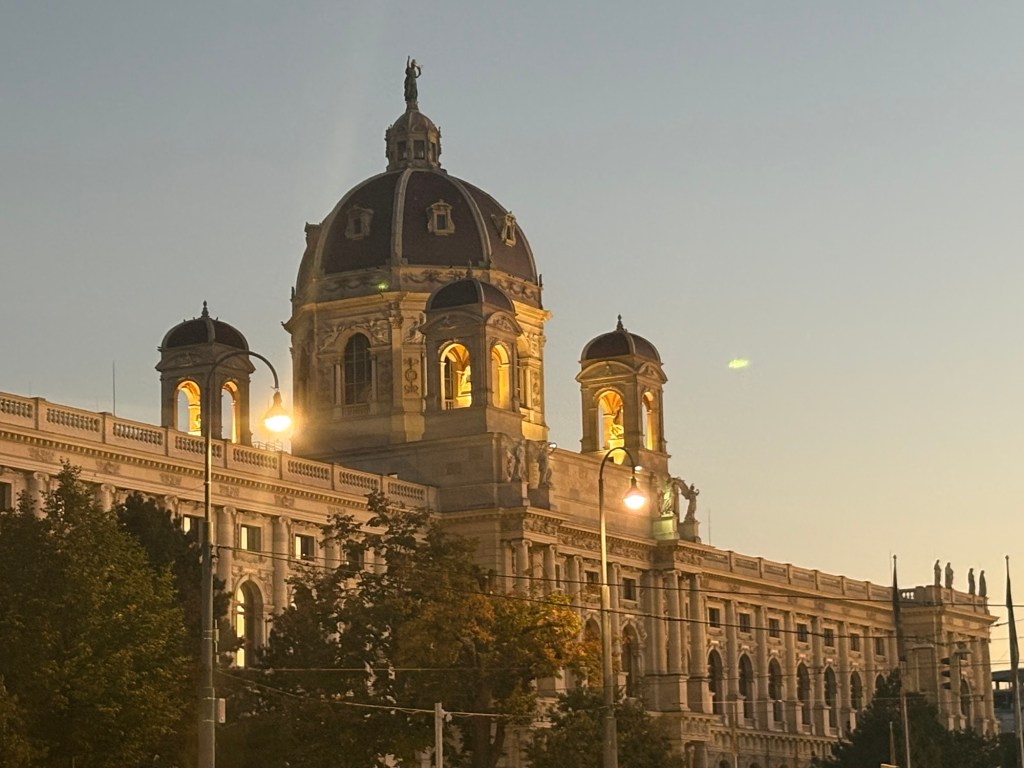
Kunsthistorisches Museum, its twin across the square is the Natural History Museum.
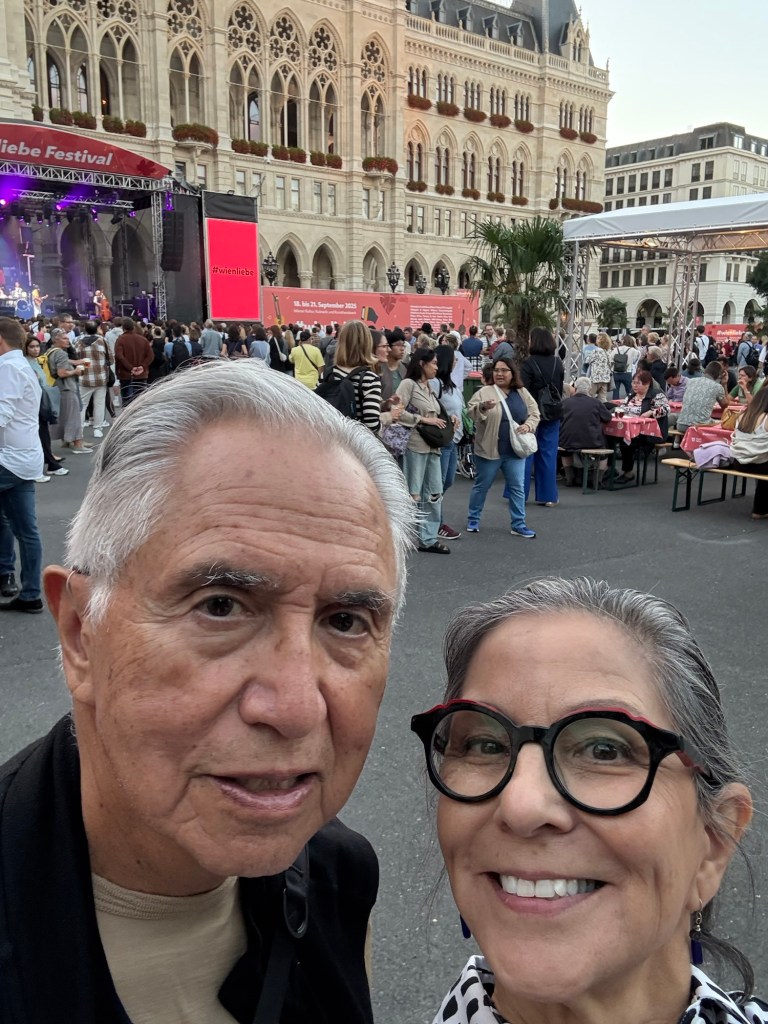
On our arrival at the airport, we found it easy to take public transit including an express train and then the subway to our hotel, Le Meridien. The fancy lodgings are in an old building sandwiched between the Secessionist building (think: Gustav Klimt and others) and the Ring Strauss. We wander out to find a festival in front of the Rathausplatz. This plaza is full of stalls selling beer, wine, brats of all kinds, honey, flowers, jewelry, and is capped with a stage for musicians. I’m satisfied with festival, but really impressed with the building. Something of it and others we see in the area are reminiscent of Venetian arches and decoration. But it’s distinctly Austrian.
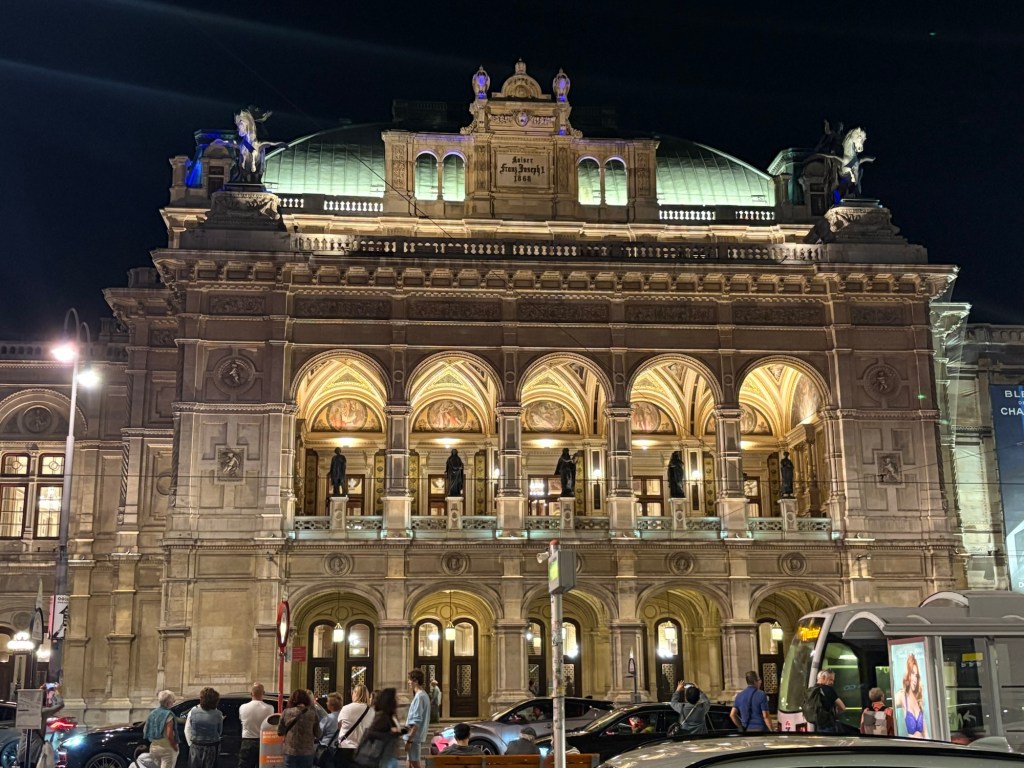
Wien Liebe FestivalVienna Opera House two blocks away. Gorgeous in the day as well as the night.
On our second and third days in Wien, we are museum-goers, seeking to understand the Hapsburg empire and the 20th Century Austria. The House of Hapsburg exhibit in the Hofburg Palace is full of medieval armor, weapons of war to keep the subjects in their place, tapestries with branches documenting the marriage of this courtly family with that one, the explanations of the upper echelons of society. It is also full of teenagers on a tour, being goofy and typically setting off invisible alarms.
Luis reads to understand more about how the Hapsburgs came to claim Mexico along with lands across the world
A deeply troubling exhibit, for me, is the Haus der Geschichte Österreich. The exhibit is well-researched, has excellent displays, is interactive and informative. But I didn’t expect the articles of torture of the Jews, their sad stories and the description of how the Austrians embraced Nazism and had their homegrown fascists to break me down. I literally choke off sobs and have to leave. Luis and I meet in the cafe later and even see a permanent exhibit on Ephesus. It turns out that in the very early 1900s the Austrians excavated Ephesus and shipped the friezes, statues and columns to Vienna. All of this history makes me look at our world map with different lenses.
I hope to write more about the fashion show and the food. No promises. We shall see. First a limoncello nightcap.
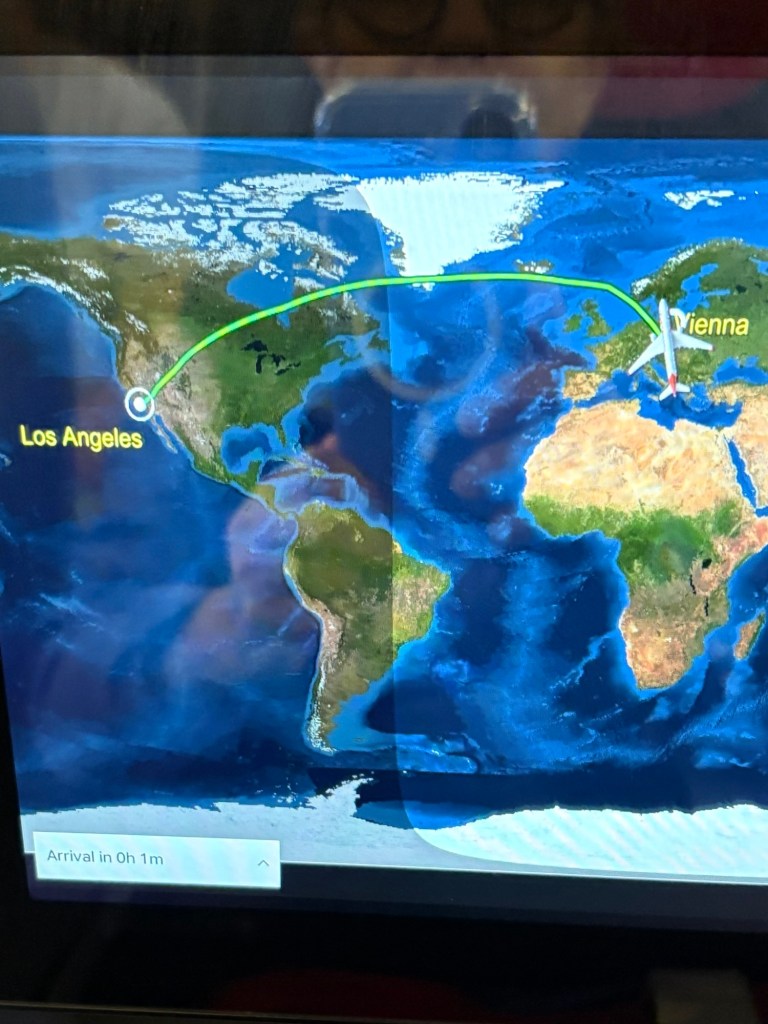
Our quick trip to Tucson was days preceding a big trip to Europe. And what a trip it’s been.
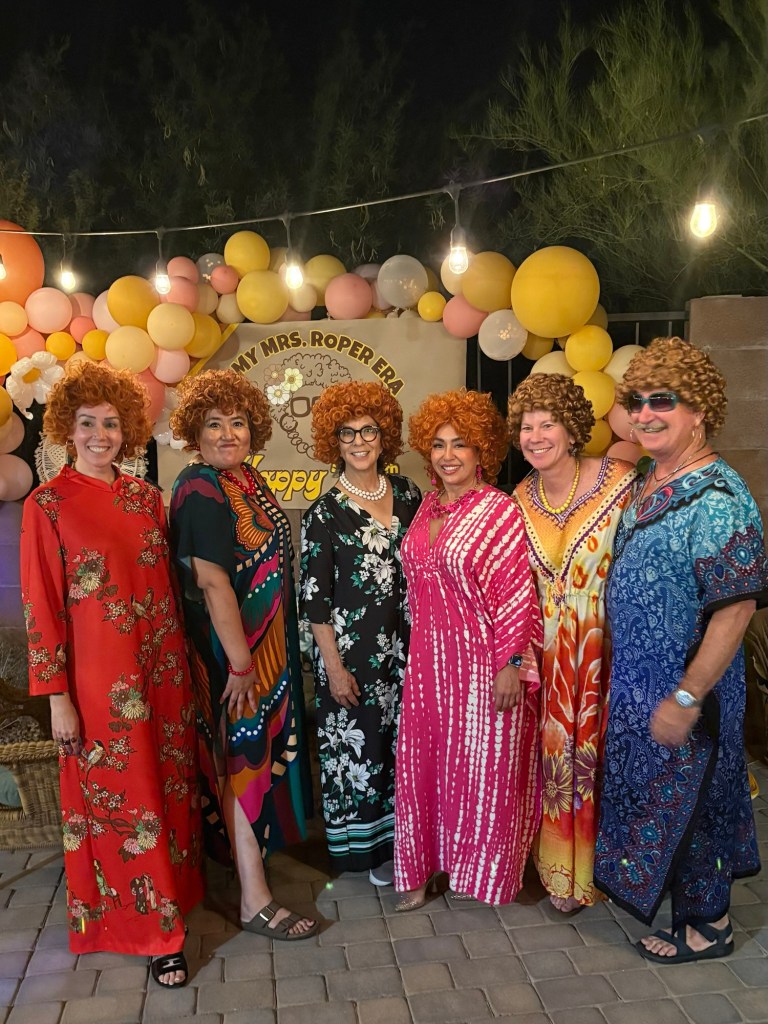
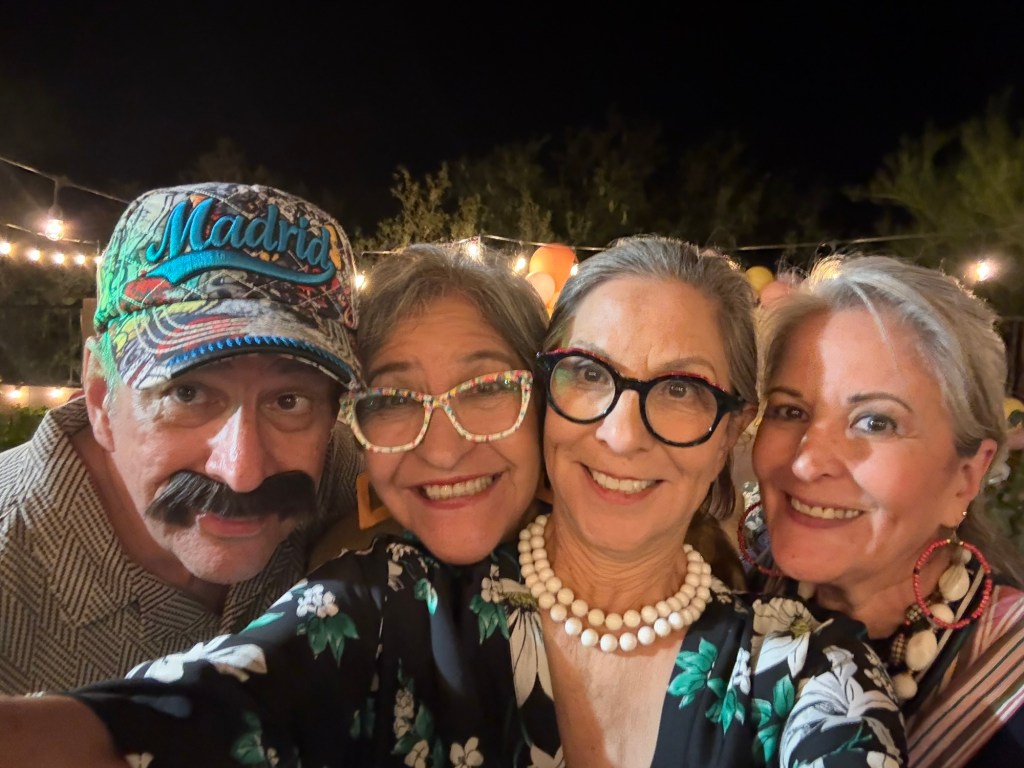
Tina is the golden goddess in the middle along with my sisters and sister-cousins
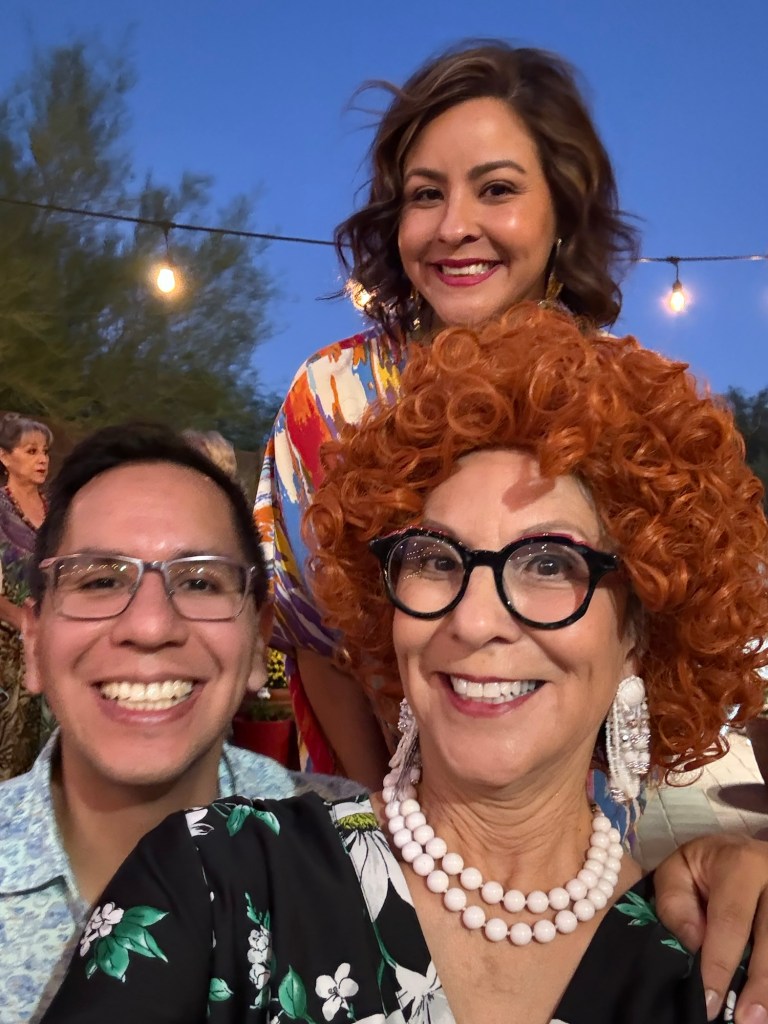
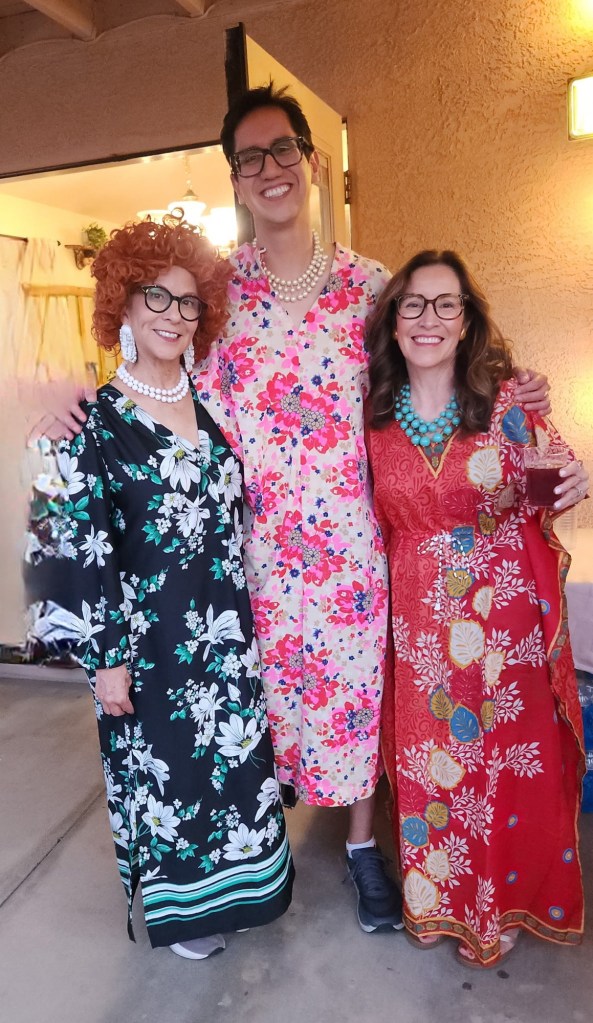
My “favorite-est” oldest sister Tina turns 70 and what a better way to celebrate than with a 1970s-themed party, Mrs. Roper style. Early on I plan to attend. Luis surprises me by saying he wants to help her celebrate, too. Then I find out Lorenzo, Miguel and Michael are all flying to Tucson, too. All my men in one place…what a treat for me.
My two sisters and one of the brothers are here.
Eddie, Tina, me and Diana. We are missing Dio
The theme provided us the opportunity to be silly. Those of us who donned mumus instantly bonded. Those of us who wore wigs bonded further as our scalps sweated in the warm night air. I have never seen so make mumus and chunking jewelry in one place. These accountremond are worn by women and men.
Most importantly, we are happy and have a deep abiding love for all gathered. Yes, there are small pockets of immediately families. Also, there is blending of the circles as party-goers weave through the tables of old high school friends, visiting family and the disco-dancing cousins.
Miguel and my niece Michelle and meMe with Lorenzo and cousin Kelly
Typical of the Madrids and Laborins (my dad’s family and my mom’s, respectively) we keep each other abreast of changing jobs, growing children, upcoming retirements and weddings, and impending vacations. Across the generations, we dance fluidly with whomever else moved by the Donna Summer or Kool and the Gang songs . We eat well and drink better. We laugh at light ribbing and cry with a cousin who lost a husband not long ago. We cry at our happiness for Tina and for each other.
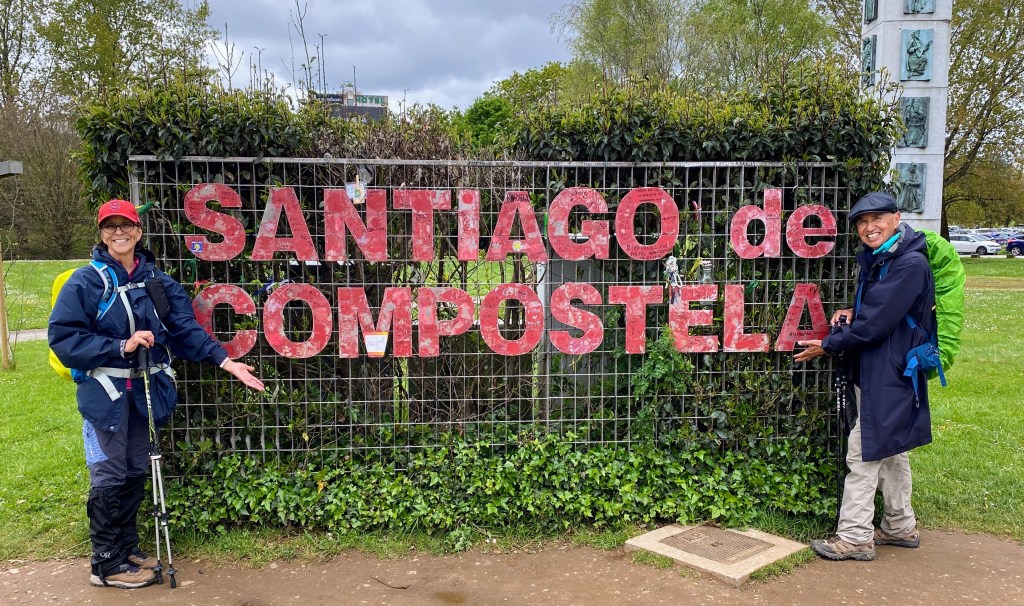
I cannot say we enter the main plaza in Santiago de Compostela, Praza do Obradoiro, with the triumphant glee you see in Instagram pictures. We don‘t dance around in the bright sun-filled Praza. We don’t kiss the earth or hug the statue of Saint James. We don’t even hug each other. There is no rapture. Not today, anyway. Yet, we make it together. We have encouraged each other and taken care of each other (and others, I hope) on the Camino. We enter the city of Santiago relieved, happy with the constant guidance of yellow arrows and shells. At the entry into the first real city on our Camino, we ham it up at the sign that announces the city. Ahead of us are still around 3.5 miles of uphill, confusing streets and alleys, and the worst rainstorm of our Camino replete with hail. When we finally enter the Praza, our goal, we are at the end of our pilgrimage. Still, I have to process the accomplishment, to think about its meaning and its function in my life. Today was a challenging 14.5 miles and the last few were hard-won. Maybe that’s how life is.
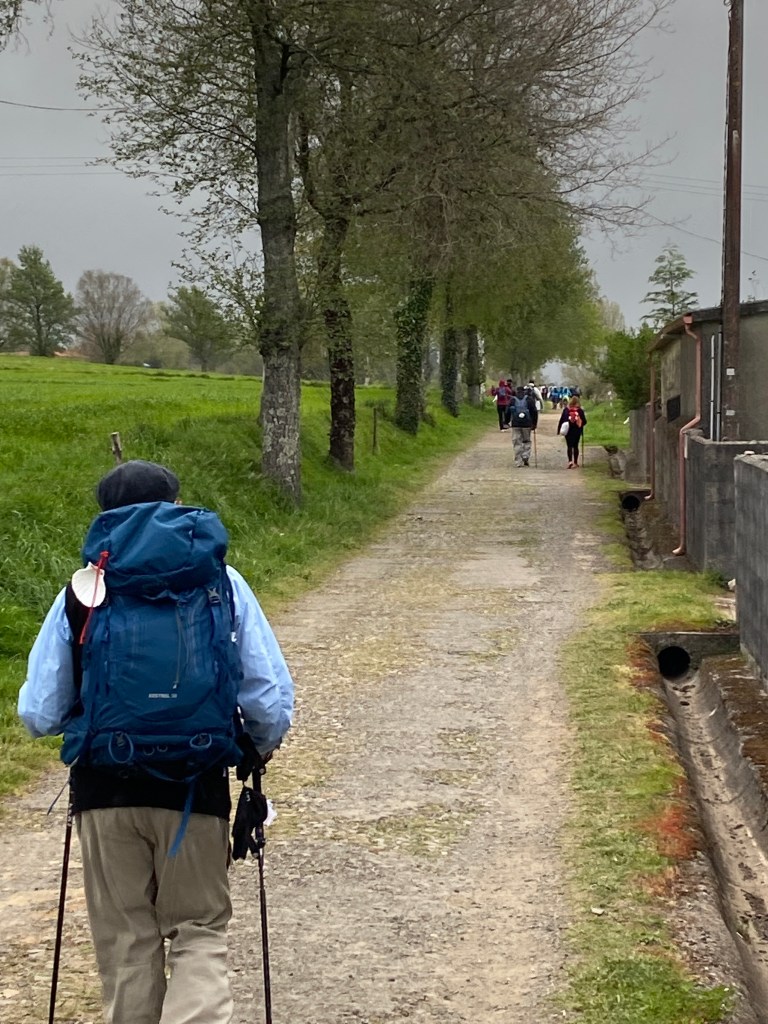
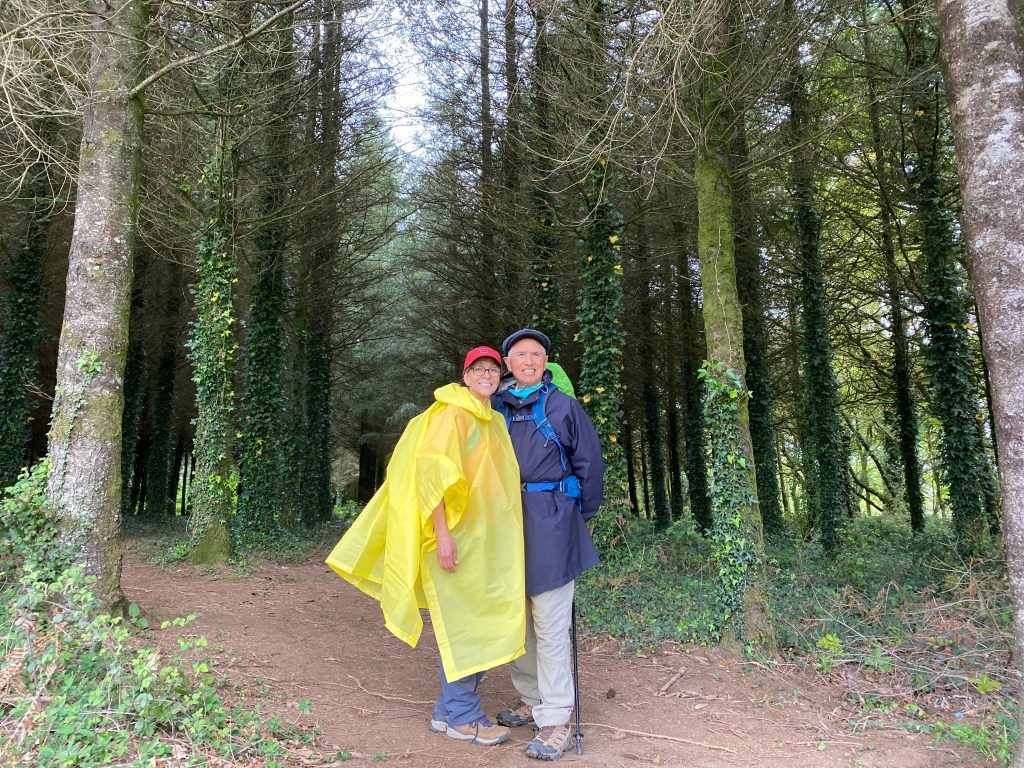
Let me put the last day in perspective. We start the morning with cold rain in O Pino (also known as O Pedrouzo and Arca). Like all pereginos we eat a hearty but simple breakfast. I stow the uneaten croissants and fruit in my gear for later because I’m burning over 3000 calories a day, according to Fitbit. I can’t get enough food. Our destination is “near” and we start walking on our final stage under a silver mist that turns to a dull pewter gray rain. Keeping my snacks company in Sofia, my newly named backpack, are gaiters, extra socks, rain poncho, cell phone, printed directions to our hotel in SdC, and an extra down jacket. We easily find our yellow arrows skirting the town. Our first chat of the morning is with an español who already has his rain poncho on in the thick rain. As he passes us, he says, “¡Que desmadre!” in reference to the soaking now coming down slowly and heavily from Payne’s Grey clouds. We catch up to him later, but for now, he trudges past us on the steep elevation rise. Luis’s rain jacket is doing its job, but I need to change out of my windbreaker and don my rain poncho over my goose down. Everyone along the Camino trail has a hodgepodge of brightly colored raingear from all over the world. This is quite a different European fashion runway. Meanwhile, I try to focus on the soft edges of the trees and distant hills, the proximity of our goal, and the beauty of the rain. There is farming out here, alternating with patches of trees and some forests, too. But there is so much rain and this is sloppy walking. Focus, Rosana, focus! You wanted this. You worked and trained for this. The natural beauty is overwhelming. But it’s hard to see through my rain-dappled glasses. Focus, already. It might all be an allegory for attaining a challenging goal. Then I step into another mud puddle and lose my focus. Sigh.
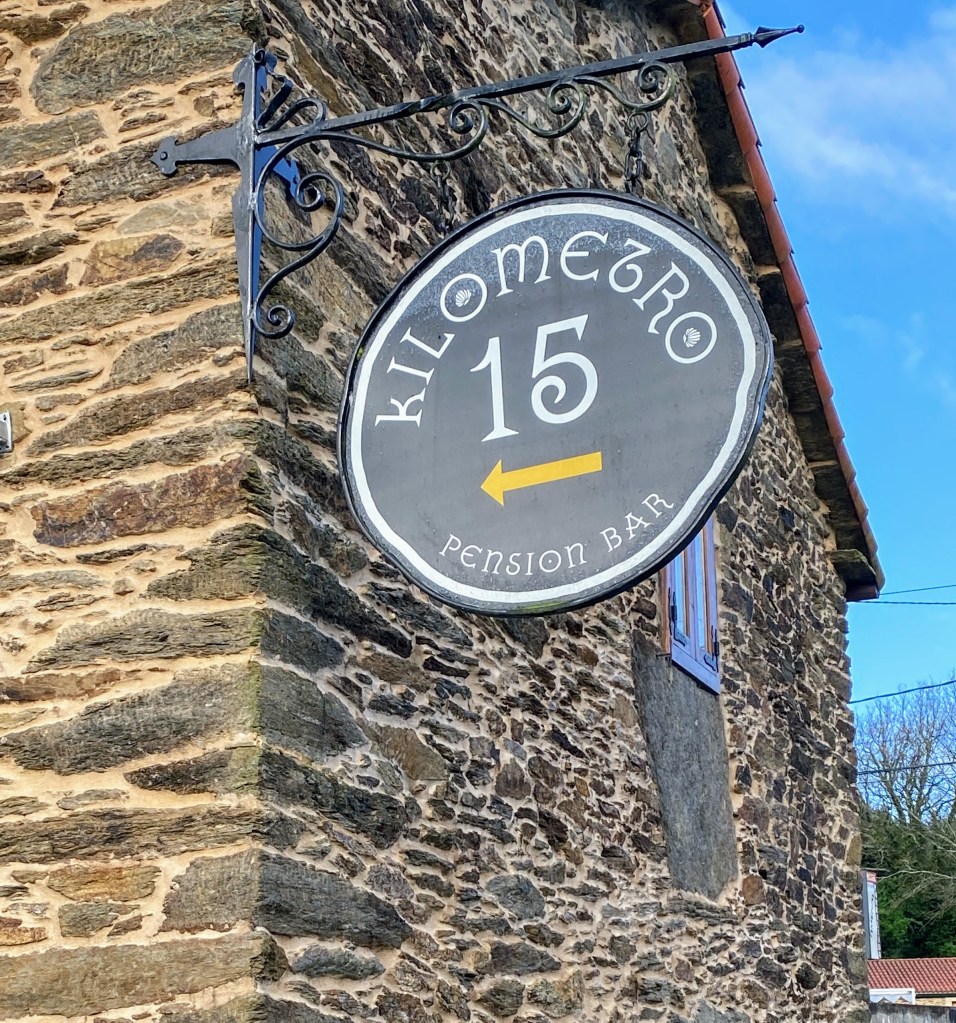
We continue and before you know it we’ve tackled 8 km (5 miles) and we have only 15 km (9 miles) more to go, assuming we don’t get lost. The sky looks cerulean and we stop at a cafe bar, Kilometro 15, popular with a mountain of walkers. We get the coveted stamps in our credentiales, I stretch my hips, my thighs, and my lower back, and Luis uses the bathroom. And we are off again. I shake off random drops of water on my poncho and we start another ascent.
With the sun warming me, I can get back to focusing. I’m under the misconception that this is the way it will stay for the remainder of the day. We climb up gentle hills. I’m still garbed in my fancy, 6-Euro yellow poncho. Another name for it is a mobile sauna. As much as I don’t want to stop, I have to before I pass out from the heat I’m building by walking inside of the plastic and down. We find a patch of shade and, like most others on the trail, I begin the process of disrobing from the poncho, unzipping the jacket, stripping off the gloves.
On we go, metaphorically skipping along in the sun and shade cast by trees. In reality, we are putting one foot in front of the other. Much like our daily lives at home, we go forward and from time to time, turn around and see the beautiful path and surroundings we traversed. This reminds me of the adage about not seeing the forest for the trees. Right now I promise myself to remember this view, to hold on to the beauty of the Galician countryside on full display, to imprint it in my memory.
The rain returns. We stop so I can extract the poncho from its pouch, fight with it to put it on, and put on the backpack. Nope. I have to strap on the backpack first, readjust the straps, snap the hip belt, then the chest strap, make minor adjustments on the lengthening straps, THEN fit the poncho over it all. I look like a kindergartner trying to get dressed in her mommy’s evening gown. Everything is too big, I put it on inside out and have trouble putting my head through the neck. And now there’s a breeze. Luis indulges me with this costume addition. All is set when the clouds break apart to reveal a blue sky. I am starting to agree with our fellow traveler, ¡Que desmadre!
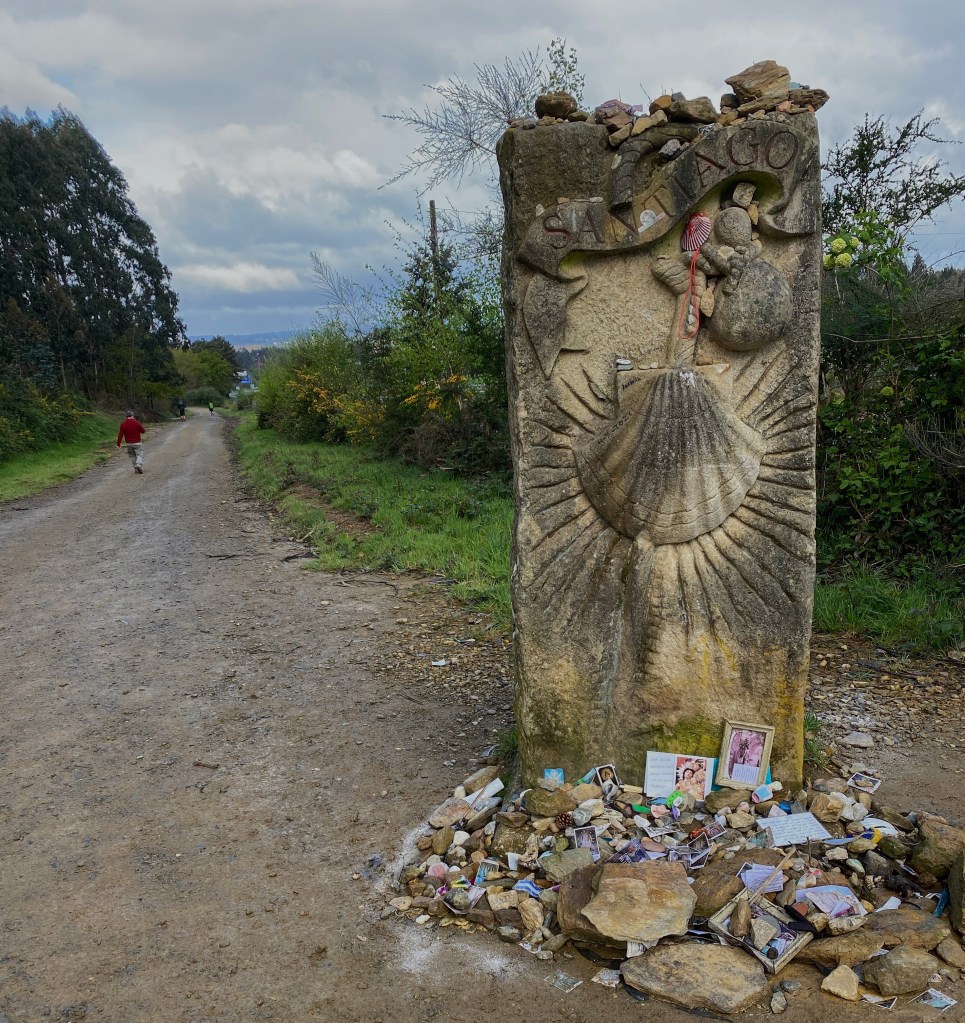
Two moments of connection catch us off-guard. We stride alongside our Spanish friend from earlier. I dubbed him “Señor Que Desmadre” but his name is Javier. He is from Madrid and committed to the Camino with a couple of friends. Delicately he wants to know how old we are. He wants to encourage his mom to go on Camino though she says she’s too old. Hmmm. Both Luis and I are older than his mom. In reflection, I realize there are few older than us on the Camino today. Maybe none. With Sr.Que Desmadre, we discuss life goals and what is important, the history of language imposition as a means of subjugation. And then, just like that, he is out of our lives. We round the bend and realize we have ascended our high highest elevation of the day as we go along the perimeter of the Santiago airport. Here is our second unexpected connection, this time more intimate. Our path wraps around the end of the airport and to a stone monument where people have left prayer cards, stones, and handwritten messages. We pass it. I backtrack realizing this is The Place. This is the place to spread Lenny’s ashes. He would like it here on a high hill, outside on the Camino. I suddenly realize the rainwater on my face is in fact tears. I miss Lenny and can only imagine the grief Tina endures for him. Seven years ago, the two of them made the Camino together while Luis’s cancer reemerged. Lenny and Tina arrived home from Santiago and came straight to visit us and encourage us to make the Camino. We had no idea that Lenny would be diagnosed with cancer and succumb to it. I pray that he knows we are following his advice.
The heavens continue to test us today. We are happy to spot a sign that other pilgrims are snapping photos of. It announces that in the next community there are not one, but two cafe bars! Glory be! It’s a town with sanctuaries from the elements. The deluge has begun again driving all travelers into these sheltering beacons and into the small stone chapel.
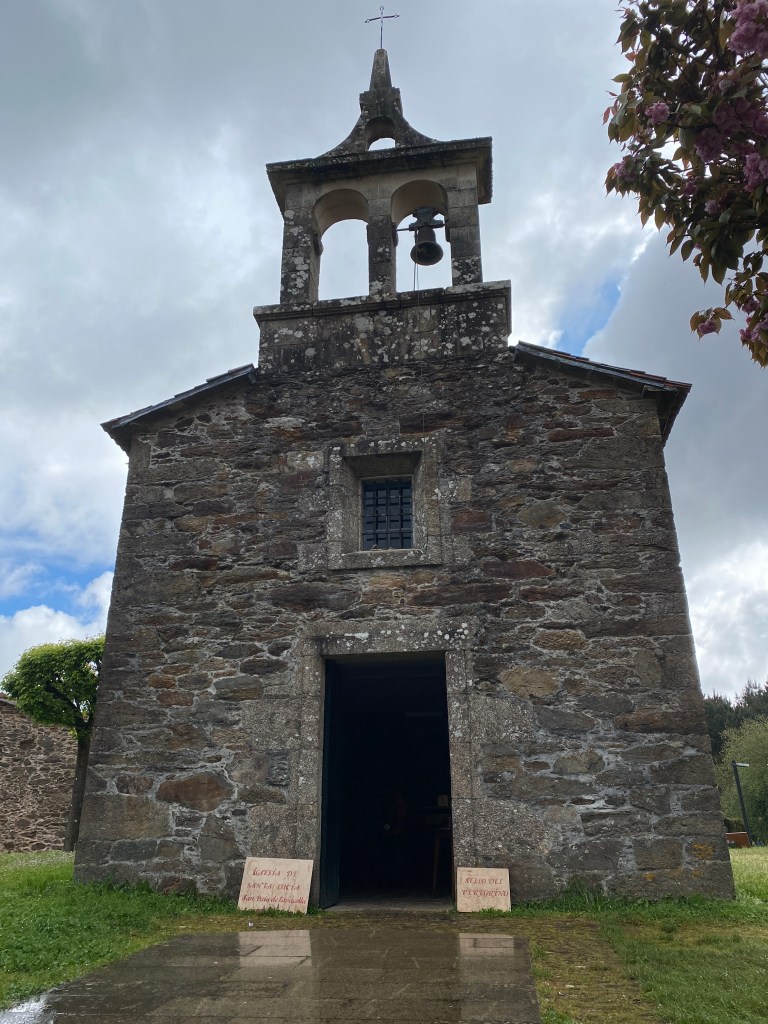
A Camino volunteer sits at the entrance to the stone chapel. She provides assistance to weary and wet pilgrims and a stamp. In her florescent orange vest and in her Italian-accented Spanish, this middle-aged, well-groomed woman welcomes us and gives us a stamp on our credentiales. She tells us she lives near Milan and comes every year to volunteer along the Camino. She invites us into the stark stone chapel from the 1400s. She, too, finds refuge from the rain. It has stood over the centuries through many rainstorms and has provided a shelter for countless pilgrims flowing like a gathering river to Santiago. After a silent prayer, we thank the Italian and cross the little lane and find one of two cafe bars, order espressos, and eat the bananas and croissants as a second breakfast. Hobbit-style, I’m already wondering about the next meal. We make fast friends with fellow travelers, including a man about Luis’s age (mid-70s) who’s a retired teacher from the Netherlands. We will see him later at the Pilgrims’ Office and in the Praza Obradoiro in Santiago, ah, but I get ahead of myself. Two women from Mexico, one of them a teacher, strike up a conversation with us. They tell us they just knew we were Mexicans because of our accents. We enjoy a regular old educators’ conference in this cafe bar with four tables and no less than 20 dripping pilgrims. We can’t stay, though, so I slap on my gaiters and we stride out refreshed and happy we’ve visited with such pleasant people.
The rain slackens off and we enter Lavacolla which has another serene church, Igrexa de San Paio de Sabugueira, and a huddle of homes. We nod to a lady coming out of her home and she wishes us another “Buen Camino.” I’m getting hungry but there isn’t any place to eat and we MUST be approaching Santiago. We dip into the valley and pull out of it again, passing a most impressive scene of large, communal washing basins along the bank of the river. The walls of the laundry pools are made of gigantic slabs of granite. We cross a bridge and then up another hill. Our Norwegian friend easily passes us with his long strides while we are pulled out to remove a layer of clothes.
We are seeing more industrial sites, a television station complex, and the beginnings of suburbs. We pass a campsite and a fence where people have placed crosses made of sticks, creating a gallery of crosses. I don’t know what it’s about. I only know that it’s likely “curated” by pilgrims.
We visit with three college students from Valencia on our final approach to Santiago. One of the three tells us about his ambitions for a start-up company that delivers made-to-order cocktails and how he will be in San Francisco for an MBA in the fall. His traveling partner tells me about how her grandparents are the only generation in her family who can still speak Valencia after the Franco years outlawed it. And, boom, we are at the sign that we’ve entered Santiago.
I think we have arrived. Little do I know that it would be another 3.5 miles of winding streets to go. And the most interesting disappearance act of all is occurring. For about 70 miles we have been guided by a clearly marked route across the countryside. Now the arrows have dissolved. There isn’t a shell to be found. Maybe the rain is playing tricks on us. It’s like the great Nile River that disappears into the delta, like Amelia Earhart’s journey across the Atlantic. The temperature drops and so does the precipitation. We manage to keep going and then “the Camino provides.” Wet and worn out, we ask an older couple with their adult son, all on vacation from another part of Galicia, where the Cathedral is and they point the way just as the skies unleash a torrent of rain. The family insists we gather under their umbrellas. The walk us part the way to the Cathedral and the Praza. One more challenge greets the 5 of us: it is hailing little ingots which turn into larger and larger stones. We all plaster our backs against ancient buildings hoping to be spared. Water gushes downhill making the cobblestones slippery. The family gets us close to the Cathedral. We follow the sound of bagpipes and stumble through the arch on the Praza! I realize this is no Kodak moment. Our accomplishment is to be contemplated later. We need to find our hotel and food. Especially, food. We try to follow our printed directions to the Hotel Costa Vela, but get lost. Asking for directions from some local men, we don’t understand their references to landmarks and we go the wrong way. We zigzag through these medieval streets without the benefit of street signs. We ask another local gentleman, and he sends us off in another direction. Again, it takes us further afield. The Camino doesn’t want us to stop walking. But my stomach does. We eventually find our hotel and we can shed our hiking clothes for fresh ones. We head down to the glass-enclosed terrace bar. They don’t serve food, they say, and yet, suddenly they’ve brought me the best-tasting jamon serrano, olives, and homemade potato chips to go with our wine. There is much to consider and analyze, but for now, I’m savoring the moment, the wine, the jamon, the warmth of the cafe bar, and my husband at my side.
I feel like a farmer, checking and rechecking the weather report, scanning the sky and calculating what we will be doing at what time of day in relation to the temperature and the sky. It looks like our partly cloudy skies will be dropping rain throughout the day. It makes the farewell to the Pazo in Arzua bittersweet. Is it a Purple Rain day or a Rainy Days and Monday Always Get Me Down day?
The Camino is full of more and more people, like a river flowing in one direction. We see a salmon, a man doing against the flow. In the quick passing, he tells us he made it Santiago and is now returning to Norway. To Norway! He’s not the first peregrino we meet that is traversing a round trip. I simply cannot imagine the toll on his body, and the joy in his heart to return home using the same mode of transportation he started with. Regardless of the number of fellow pilgrims, Luis and I are always together, or separated by only 10 or 20 feet at the most.
This is the best part for me. Just walking and spending time with Luis. We are often silent in our own thoughts. And there times that we share reflections. Today we talk about the grandbaby changing daily. We talk about our incredulity of living through the Pandemic (so far, anyway), of living through some of the biggest earthquakes of recent years (Loma Prieta in 1989 and Humboldt County, 1994), of the joys of raising Lorenzo and Miguel, of the happiness for Lorenzo having found Arevik, such a wonderful wife, of the plans we have for the future, of my retirement in the not-too-distant future.
We sing, too. We dredge up songs from elementary school days, from our sons’ music classes, from the radio.
Listen. Do you want to know a secret? … We may never pass this way again … Far, a long, long way to run … We may lose or we may win, but we will never be here again …
It passes the time without the help of the internet to Google every question that pops up, without the convenience of listening to Pandora, without the current news analyses of Morning Edition or All Things Considered.
We discuss the possible developments of the war Putin is waging in the Ukraine, What could be the next steps.? Is nuclear war on Putin’s mind? Will the world be swept into World War III? The proximity of Spain to the war is evident in their worry and in their news. Even in the small bars along the Camino, there are signs of support for Ukraine. Spain is barely emerging for a tragic mortality rate from the Pandemic and the country is slowly reopening. It was just a few months ago, the Spanish government opened the borders to foreigners. At every Mass we’ve attended and in the vestibules of the churches, there are homilies at the altars and fliers and posters in the vestibules praying for an end to the war and soliciting support for humanitarian aid and reunification of refugees.
….Imagine all the people living life in peace. You may say I’m a dreamer, but I’m not the only one…
Like this we walk for another 10 or 12 miles. We chat with a Spanish family, a mom and daughter pulling ahead and the dad/husband falling behind. He’s limping and in listening to him, as Luis pulls in front, I find he’s had multiple surgeries and the doctors have removed a cancer-filled kidney. The cancer has spread but they aren’t worried too much because it’s stable. He just wants to complete the Camino.
Later, in a waterlogged grove of moss covered oaks, we chat with a couple from Uruguay. We take turns taking photos of each other, creating proof that the two of them were together and that Luis and I are together on the Camino.
We doubt we will see either group of travelers again, but it would be nice if we were to. We have many more soggy miles to go to get to the last night before our destination. The town we are aiming for is ancient and has had different occupations, cultures and languages, giving the town the names of Arca, O Pino, O Pedrouzo. Meanwhile, these Boots Are Made for Walking….
Willie Nelson sings in my ears as we wash clothesin the coin-op machines at the O Aciviro accommodation. Just Can’t Wait to Get In the Road Again. ~ RoMA















 Ordinary Gente